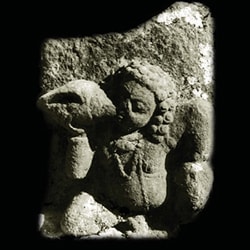
Named after a bird species considered extinct for 106 years and rediscovered in the Rara region by S. Dillon Ripley (a founder of the Smithsonian), Spiny Babbler has been used for decades as a banner for work in arts, education, and knowledge management. Its logo is that of a baman dwarf – also considered Barun, the water god – carved in stone under a stone water spout at the fourth-century Gum Vihar complex northeast of Kathmandu. Throughout its existence, significant emotion, intellect, and financial resources have been invested under the Spiny Babbler name to deliver high-quality work to institutions, individuals, and projects. Pallav Ranjan founded Spiny Babbler in 1991. In the United States today, “Spiny Babbler” is used as a professional and artistic consulting/trade name for independent work by Pallav Ranjan, Bhagwati Kumari Sapkota, and collaborating family members.
Spiny Babbler’s efforts in arts, education, and communication have spanned six continents and reached deep into some of the most remote areas of Nepal. It has crossed gender, ethnic, economic, educational, creative, and technical divides, and its work has been effective, inclusive, and appreciated. People from more than 14 countries have engaged locally in events, projects, and programs for at least one month or more. Citizens of the United States, Scotland, the UK, Japan, China, Laos, Bangladesh, Switzerland, Canada, the Netherlands, France, and Nepal have been involved. Schools from 20 nations – from Iran to deep China – contributed to Spiny Babbler’s effort in mountain environment education. Twenty-two universities in the Australasian region and their creative writing departments collaborated with Spiny Babbler. Over 100 leading poets, including 10 Nobel laureates or their estates, contributed to its efforts. Writers, artists, musicians, creators, doctors, development workers, social workers, and administrators have participated.
Young people who study at private schools such as Lincoln School, the British School, St. Xavier’s, and St. Mary’s, as well as those who live in shelter homes or have physical or mental challenges, have benefited from creative, academic, and entertainment opportunities offered under the Spiny Babbler banner. People with fewer resources from communities such as Sankhu, Taudaha, and Thaiba; more than 150 schools (many public or resource-challenged); children at risk in Kanti Children’s Hospital (burn and cancer units), Lagankhel Mental Hospital, and Thapathali Maternity Hospital; and shelter homes for street children, girls at risk, and children of prison inmates have been engaged. St. Xavier’s 50th anniversary (golden jubilee) saw extensive involvement and a keynote speech by founder Pallav Ranjan. Spiny Babbler was invited to speak at St. Xavier’s College 25th anniversary (silver jubilee) celebrations. Multiple donor organizations have supported products and projects.
Gender, specially-abled populations, ethnic minorities, and other marginalized groups have been engaged through humanized, individualized, customized, and specialized approaches. Spiny Babbler helped Save the Children develop a program for the health and life of children under age five. With UNDP, it prepared the Beijing Conference gender manual. It helped UNICEF ROSA prepare the earliest guidelines on violence against women and girls. It worked with ICIMOD to prepare a publication on women of the Hindu-Kush Himalayas based on a workshop that involved 270 women from six nations.
Spiny Babbler has been recognized for creativity by national and international critics including prime ministers, mayors, artists, writers, and social leaders. Technically explorative, its website at www.spinybabbler.org (also accessible as www.spinybabbler.com) was among the earliest in South Asia in 1996 and received a five-star rating in a Nepali Times review. It was also featured by BBC Radio’s international broadcast. Spiny Babbler produced among the first LAN networks in Nepal as well as early digital file archiving systems using QBasic programming. The first of the nation’s 3D products was produced in 2001, and a 30-minute 3D computer-generated imaging and traditional video combination was created for UNICEF. Prominent creators such as Poet Laureate Madhav Ghimmire, Lain Singh Bangdel, Mohan Koirala, Shashi Shah, and many of Nepal’s finest artists and writers have been involved.